Motocyclopedia is site devoted to organizing and categorizing motorcycle models from around the world.
Showing posts with label Retrospective. Show all posts

Friday, June 26, 2009

Touring bikes: the Goldwing saga

Prior to the seventies there were no sport bikes, dirt bikes, or touring bikes. If you wanted a fast bike, an off road bike, or a long distance touring bike, you would modify any number of "standard" style bike that were available at the time. During the seventies aftermarket companies such as Vetter, began offering accessories such as saddle bags and windshields that could transform your basic CB750 into a road trip machine. The popularity of these accessories prompted Honda to develop their own factory tourer, the quintessential road warrior, the Gold Wing. But before the Gold Wing took flight there were a number of other machines that were favorites for long haul riders.

In 1976 the Gold Wing revolutionized touring just like the CB750 revolutionized street bikes seven years earlier. Originally Honda built the Gold Wing as a performance bike. The Gold Wing featured a water-cooled flat six when, very few motorcycles were water-cooled. While the Gold Wing didn't take off as a performance bike it became a hit with the long distance traveler set.

1976 Gold Wing GL1000


The second generation saw the addition of a integrated fairing and bags, creating the look that lives on to the Gold Wing of today.

1981 Honda Gold Wing GL1100


1985 Honda Gold Wing GL1200


By the third generation Honda's competitors had caught on and had introduced touring bikes of their own. In 1983 Kawasaki introduced the Voyager. The first generation Voyager was based on Kawasaki's KZ1300 straight six street bike. Kawasaki's had more success with the second generation the Voyager XII (12) because it was lighter and more maneuverable. The same year the Voyager arrived Yamaha introduced the Venture. A couple years later Yamaha would use the Venture's V4 engine in their VMax sport cruiser. Suzuki was the last to the party with the Cavalcade. Like the Yamaha, Suzuki used their V4 cruiser engine in the Cavelcade. This motorcycle was the most powerful of the four, but it was also the heaviest, and eventually it was the most short lived.

1983-88 Kawasaki Voyager 1300
1989-03 Kawasaki Voyager 1200


1983-93 Yamaha Venture 1400


1985-89 Suzuki Cavalcade 1400


The competition never could match the popularity of the Gold Wing. Over the years they each dropped out of the segment. The only real competition the Gold Wing faced were Harley Electra Glides and BMW LT's, but both of these bike were different enough to cater to a different type of rider. With the market nearly to itself the Gold Wing grew to be one of Honda's best selling and most profitable models.

1991 Honda Gold Wing GL1500


2006 Honda Gold Wing GL1800


Touring bikes: the Harley-Davidsons story

American culture seems to lend itself well to touring motorcycles. Long open roads that are plenty wide and cheap gas make the perfect habitat for big dinosaur bikes. It's because of this Harley Davidson had an early start in touring motorcycles. Since World War II (maybe even prior to) Harleys could be had with windshield and saddle bags.

1946 Harley FL (Knucklehead 1000cc)


1952 Harley FL Hydra-Glide (Panhead 1000cc)


These early touring bikes were prefect for America's long straight roads. Harley's tourers took off with the FL model (which has evolved to Harely's current touring line-up) and introduction of their overhead valve engines (starting with the Knucklehead). In 1949 the FL replaced the front spring suspension with hydraulically dampened forks, creating the Hydra-Glide. Rear suspension was added in 1958 replacing the ridged frame and creating the Duo-Glide.

1959 Harley FLH Duo-Glide (Panhead 1000cc)


1970 Harley FLH Electra Glide (Shovelhead 1200cc)


1989 Harley FLHTC Electra Glide (Evolution 1340cc)


2009 Harley FLHTCU Ultra Classic Electra Glide (1584cc)


The 2009 models might look very similar to yesterday's models, but they are full of updates such as fuel injection, CD players, and ABS brakes. Today Harley's line-up of touring machines is made up of several models each with different features and equipment.

images from 20th century motorcycles

Monday, January 12, 2009

The stars of BSA: A10


Golden Flash 1950-61
In 1950 BSA introduced the Golden Flash. The Golden Flash was an evolution of BSA's first parellel twin the A7 (500cc's). The a 650cc parallel twin would go on to define British motorcycles for the 1950's and 60's. Golden Flashes came from the factory with a distinctive gold paint job. 35hp 100mph

Road Rocket 1954-58
The Golden flash gave birth the the Super Flash and Road Rocket. The Road Rocket continued the evolution of the BSA twin. The 650 twins were targeted to US customers for their need of power and speed. 40hp 109mph

Super Rocket 1957-63
The Super Rocket was the next step after the Road Rocket.

Rocket Gold Star 1962-63
A Super Rocket engine in a Gold Star (single) frame.

The A10 was replaced by the unit constructed twins of the 1960's. The A65 star twin replaced was the next evolutionary step.

Monday, January 5, 2009

Kawasaki Concours

The Kawasaki Concours, or GTZ in Europe (ZG1000 and 1400).

In 1986 Kawasaki built a sport touring bike around the then-new Ninja 1000. The big liquid cooled dohc inline four made for a heavy sports bike, but was a perfect fit for a sport touring rig such as the Concour. The bike was so good that it went virtually unchagned for over two decades. Concours competed closesly with Honda's ST1100, which also went on to live an unnaturally long life.

After over 20 years of production, the first generation Concours was replaced by the second generation in 2007. The new Concours 14 uses the fresh 1400cc inline four from the ZX-14 hyperbike.


Friday, December 12, 2008

Honda RC51


Few motorcycles have this many names. The Honda RC51, VTR1000 SP1, or RVT1000R just don't call it slow. Th RC51 was a unique departure for Honda, and it has become somewhat of a one hit wonder.

Back in the 1990's Honda's V4 RC30 and RC45 battled in the Superbike World Championship against Ducati's, Yamahas, Suzukis, and Kawasaki's. Honda, apparently, had enough of campaigning their 750cc V4s against Ducati's 1000cc V twins, and decided, "if you can't beat em' join em'." Honda indroduced the RC51 in 2000. The beast sported a 1000cc 90 degree V twin (just like Ducati). On it's first year out the RC51 won the Superbike World Championship with Collin Edwards. The bike would remain competative until 2003, when the rules changed to allow 1000cc four cylinders, and Honda dropped the factory support. The Honda CBR1000RR would go on to fill the spot of RC51.

Monday, December 8, 2008

Crocker

Perhaps the most premium performance motorcycle company ever to come out of America, was Crocker. I like to think of Crocker as the American answer to the Brough Superior or the Vincent Black Shadow. Albert Crocker worked at Thor motorcycles before becoming an Indian dealer. He built motorcycles around Indian's 750 Scout engine. The company then moved to building a 500cc single racer. The racers were well developed but were underpowered. After the singles Crocker produced their infamous V twins.

The Crocker V twins featured an overhead valve layout, with hemispherical combustion chambers, in other words it had a "Hemi" (long before Dodge ever did). The 1000cc twin had considerably more power than Harleys and Indians of the day. Displacement was increased to 91cid (about 1500cc's) making it one of the largest production motorcycle engines for decades. The V twins lasted from 1936 to 1942. After World War II Crocker ceased production.
In 1999 a "new" Crocker arrived. A company that began making parts for vintage Crockers. The C4 Concept was introduced in 2007(?).

Thursday, December 4, 2008

Ariel Square Four

Before Edward Turner made his name with the quintessentially British "parallel twin", he dreamt up the square four. He pitched his idea to Ariel and so began the Ariel Square four. The square four is basically two parallel twins back to back. This configuration makes for smooth revs and a very compact size. The main drawback of the air-cooled square engine was the lack of cooling for the rear cylinders. The Square Four lasted from 1931 to 1958. Initially the engine displaced 500cc's, but it grew over the years to 1000cc's. The Square Four may not have been the raciest bike during the time, but its power and smoothness made it a great sport tourer. After being acquired by BSA in the 1950's Ariel focused on two stroke commuter bikes, abounding the Square Four program.

Apparently nothing sounds like a square four.

Laverda superbikes

Like most Italian motorcycle comapanies Laverda became popular in the 1950's and 60's with small capacity bikes. The company racked up some racing trophies racing against a sea of other lightweight European machines. In the late 1960's Laverda moved into the large capacity market.

The company started with 650cc parallel twin, and later introduced a 750cc version. These bikes were built to be racers first, road bikes second. The bikes were painted orange so they would be more visible during endurance races. Built using only the best components, Laverda twins were expensive, and only a handful were built. Laverda sold in the USA as "American Eagles", for a reason I'm not entirely sure of. A purpose built racer called the SFC (S for sport, F for "freni" (Italian for brakes), and C for competizione) followed shortly.


Laverda also produced this race-only V6 bike.

In the 1970's Laverda upped the ante with the 981cc triple. It was big, powerful, loud, and most importantly, fast. Like Laverda's past models the triple was a racing success. In 1976 a British importer introduced an upgraded version known as the Jota.


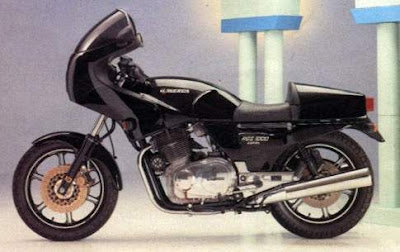
Laverda was on its last legs by the mid 1980's. The company came out with the RGS 1000 a sport touring bike with some clever fairings and integrated saddle bags. A sport version of the RGS came out next using the SFC name, the SFC 1000. Both bikes were fine motorcycles, however they were based on Laverda's 1970's triples, and were terribly outclassed by Japanese competition.


A serious attempt to revive the Laverda brand produced a number of really interesting motorcycles in the mid 1990's. The company launched a completely redone 650 twin, and later a liquid cooled 750. More models were planned including a series of 750 models known as the Ghost, Strike, and Lynx.


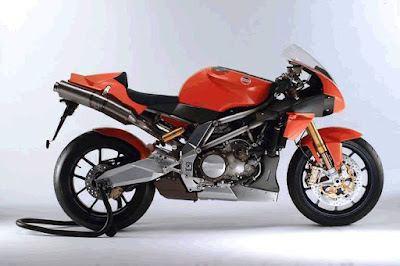
In 2000 fellow Italian motorcycle maker Aprilia bought the rights to Laverda. The only thing to come of this was a 2003 concept called the 1000 SFC prototype. The concept was a modified Aprilia RSV 1000. The bike was never produced, and Aprilia was later sold to Piaggio, where Laverda's name collects dust.

Monday, December 1, 2008

Y2K turbine bike


In 2000 Marine Turbine Technologies Inc. introduced the Turbine Superbike, better known as the Y2K Turbine bike. The bike uses a Rolls Royce turboshaft engine commonly used in helicoptors. This engine developes 320hp making it the "most powerful production motorcyclein the world" according to the Guinness Book of World Records. With that kind of power the Y2K can reach speeds of 227mph. Of coarse this much bike isn't going to come cheap, the Y2K costs nearly $200,000.

The Rolls Royce Allison 250 comes straight out of a Bell Jet Ranger helicopter. MTT gets the engines used (once an engine surpasses a running limit the must be rebuilt). Normally running on kerocene, the turbine engine has been converted to diesel.

For 2008 MTT is offering their "streetfighter" model. It isn't a streetfighter in the sense of a naked bike like a Triumph Speed Triple or Ducati Monster, but it does have 420hp!
For an excellent video on the machine click...

Saturday, November 8, 2008

Rotary Motorcycles

Felix Wankel built the first working rotary internal combustion engine in 1957. The engine first appeared in the German NSU spider in 1964. During the late 1960's and early 1970's a lot of people thought rotaries were the way of the future. Wankel rotaries were designed for airplanes, cars, snowmobiles, and yes motorcycles. The first motorcycle to get this revolutionary powerplant was the Hurcules W2000 in 1974.
The W in W2000 was for Wankel. Followed shortly after the Hurcules was the Suzki RE5 in late 1974. Suzuki at the time was producing primarily small two stroke motorcycles. Honda and Kawasaki began shifting twoards large displacement four stroke street bikes, and Suzuki had nothing to offer. So what did Suzuki do? They came out with a large displacement two stroke and a rotary powered bike. Like most rotary powered vehicles the RE5 was very smooth and capable of high RPM's. The RE5 however produced a lot of heat and was prone to overheating. Combine this with the lack of demand for a rotary motorcycle and the RE5 only lasted three years (1974-1976). One has to wonder if bikes like this discourage Japanese companies like Suzuki from tring new designs.
Yamaha also had a rotary ready called the RZ201. After witnessing the failure of the RE5, however, they axed the program after a prototype was displayed in 1975.


The last manufacturer to play with rotaries was Norton. Norton's rotary development started back in 1969 when the English motorcycle industry was on its way to extinction. Norton decided to take a chance with rotaries and a working prototype was produced in 1977. Norton began selling selling these machines to law enforcement agencies in the early 1980's as the Interpol II.
Norton produced 100 civilian motorcycles in the late 1980's, all of which were quickly snatched up by collectors. A liquid cooled fully-faired model called the Commander was offered afterwards.

Perhaps the most interesting Norton rotary was the F1 racer. Norton's racing rotaries did rack up a few victories, including the Isle of Man TT and the British Supercup series. Early models had issues with heat build up from the air cooled engine, later models fixed the probelm but it was too late for Norton. The company finally went belly up and only 66 F1's were ever produced.

Wednesday, October 1, 2008

Twilight on the 2 stroke

Two stroke road bikes have been extinct for quite some time now. These noisy beasts just couldn't fit in a quiet, clean, P.C. world we live in today. It's a shame as they offered a unique experience to the two wheeled world. Here's some of the last remaining models (larger-bore road only models that is).
The 1970s saw the biggest 2 strokes. With 750cc monsters like the Kawasaki Mach IV and the Suzuki GT750. Yamaha had perhaps the most popular ring-dings with their RD series.

Yamaha RD350
Kawasaki Mach III 500
Kawasaki Mach IV 750
Suzuki GT750
By the end of the 1970s there weren't many 2 strokes left. After a lot of work Yamaha managed to pass their sweat RZ350 into the US market, but it was pretty clear that 2 stroke steet bikes were a thing of the past.

Yamaha RZ350

Of couse there's the famous RZ500, or RD500LC if you perfer. A limited not-for-US sports model made to be a road going grand prix bike.

Like Yamaha, Suzuki had a 500cc 2 stroke. The RG 500 Gamma was produced in the late 1980's. Apparently Suzuki continues to produce smaller RG's elsewhere in the world.

The last 2 cycle road bikes (that I know of anyway) has to be the Bimota V Due. In 1997 Bimota made its first and only bike with a Bimota engine. Bimota's first engine was a 2 stroke 500cc V twin. Unfortuanately the V Due had numerous problems and was the last nail in the coffin for Bimota at the time. It's a shame as the bike looks fantastic.